


The challenge is not solely to capture text. A freely formulated request must be translated into reliable data for the quotation process. This requires extracting relevant information from the message and recognizing missing details. Are the item numbers plausible? Is information missing? Do further inquiries need to be made?
This is precisely how our RFP Agent works: it analyzes incoming quotation requests, recognizes missing or unclear information, and can automatically ask follow-up questions. Once the information is complete and verified, it passes the request on to the sales process.
From Email to Quotation
A freely formulated customer request rarely contains exactly the data structure that an ERP or CRM system needs. Instead of entering item numbers, quantities, and other details in clearly separated fields, each customer formulates its request in the way that is easiest for people.
This is where our Agent comes in. It analyzes the message and extracts the information relevant to the quotation process. This includes, for example, item numbers, product details, quantities, and other concerns. A clearly defined sequence then follows:
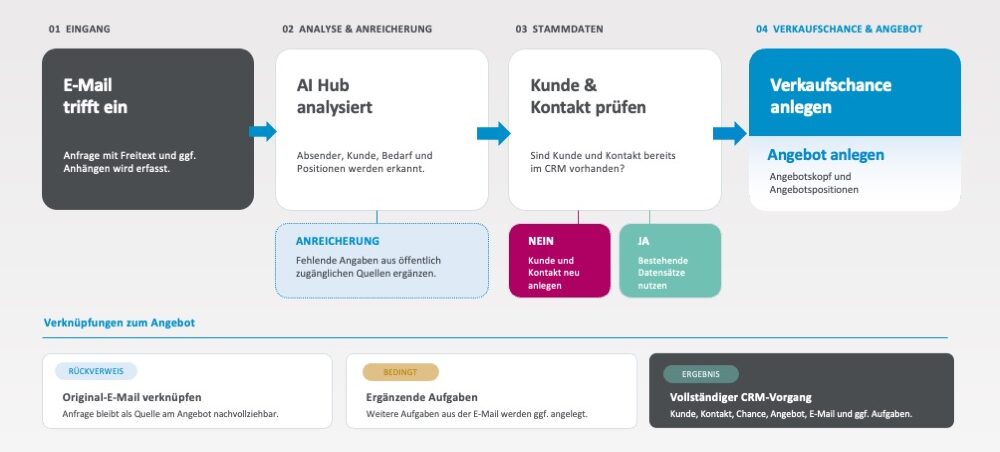
Receive email → Analyze content → Check information → Ask for missing details → Re-analyze response → Create offer and sales opportunity
The RFP Agent: More Than Just an Email Assistant
A classic email assistant can summarize a message or draft a reply. Our RFP Agent goes a step further: here, the AI is integrated into a deterministic business process and transfers data to CRM, ERP, or other business systems.
After the AI analyzes and prepares the message, a defined sequence with clear rules follows. In the concrete implementation, we used Power Automate in combination with AI functionality. This controlled sequence is advantageous for quotation creation. For example, if an item number is ambiguous, the system should definitely ask a question instead of searching freely for a plausible solution.
Automated follow-up questions for unclear or missing information
The Agent is designed to always ask a follow-up question when uncertain, rather than working with a plausible-sounding assignment. In addition to semantic checking, this also includes checking against existing company data. For example, if an item number is recognized, the process specifically searches for that number in the article master data. If the article exists, the information can be used for the quotation position. If the search does not yield a clear result, no automatic assignment is made.
The Agent recognizes missing or unclear information and can automatically formulate a suitable follow-up question in the company’s tone of voice and send it by email. Each interaction is also logged, so the Agent’s activities remain traceable.
The customer’s response is re-analyzed and assigned to the existing process. Once all required information is complete, quotation processing can continue.
From fax to email: the input channel is not important
Not every quotation request reaches sales via email. In many companies, requests still arrive by fax – especially where established processes, specific customer groups, or industry-specific workflows play a role.
However, for automation, it doesn’t matter whether the request arrives by email or fax. What is important is that the content can be digitally captured and processed. An incoming fax can, for example, be made available as a PDF or image file via a fax-to-mail solution or a digital fax service. Subsequently, optical character recognition (OCR) can extract the information contained. The prepared data is then processed like any other quotation request; if details are missing or unclear, the necessary follow-up steps are initiated. The quality of the template is important here. Handwritten additions, poorly legible prints, or incomplete fax pages can make automatic processing difficult. In such cases, the process should provide a clearly defined handover point to employees.

Where Does AI Really Create Value for Your Company?
Find out in our free, one-hour AI Discovery Call! Together, we’ll discuss which application areas are suitable for your organization and what implementation effort is realistic.
- confidential
- free of charge
- inspiring
Activity Logging
Quotation requests are not always limited to the actual quotation creation. A message may contain additional questions or tasks alongside the product request. The RFP Agent recognizes such additional information and can create it as an activity or task and assign it to a person.
This means that the Agent does not only transfer the actual quotation request to the CRM. Information such as another question that still needs clarification also remains in the process. This is particularly relevant for daily work: employees no longer need to evaluate the entire message, but can focus on the parts that actually require their processing.
Prerequisites for using the RFP Agent
From our experience, a successful implementation does not begin with technology, but with clear technical rules. Together with the responsible specialist departments, it should be determined what information a valid quotation request must include, which item numbers are permissible, and when a request is considered complete. It is also important to decide in what cases the Agent can independently ask questions and when processing should be passed on to a person.
Projects repeatedly show how important the quality of the underlying data is. The RFP Agent needs access to authoritative data sources – especially the article master data – so that recognized item numbers can be reliably checked and quotation positions correctly assigned. This typically requires integration into existing ERP and CRM landscapes.
For fax requests, additional components such as fax-to-mail and digital fax services are added for the initial setup, depending on the input channel.
Five questions before starting
Before companies decide to use the RFP Agent, the following questions should be addressed:
Which quotation requests repeat frequently?
Identify standardizable requests where similar manual steps always occur today.
What information is needed for a processable request?
Define mandatory information, such as item number, quantity, and other details depending on the business model.
Which data is binding?
Determine which systems provide leading article, customer, price, and other business data.
What can the AI take over?
Identify tasks where interpretation makes sense – for example, extracting information from free text, recognizing missing details, and formulating follow-up questions.
When should a human take over?
Define clear handover points for unclear product assignments, exceptions, and technical or commercial decisions.
Possible Agent expansion levels
Once automated processing is established, the process can be expanded. The Agent could, for example, suggest suitable successor products, higher-quality variants, or additional services such as warranty extensions and maintenance for requested articles. This would turn quotation creation into an intelligent sales-support process: the AI initially processes the specific customer request and can then offer additional, professionally defined cross-selling and up-selling options.
Our experience shows, however, that such extensions only work reliably if product data, business rules, and customer context are cleanly linked. This foundation is essential to ensure that suggestions are not only automated but also traceable and suitable for the customer.
Conclusion: the value is created in the process
An AI that summarizes an email saves a few minutes. An AI-powered quotation process can do much more: it understands a freely formulated request, recognizes missing information, independently asks questions, checks details against existing data, and then initiates the next business processes.
Our practice shows that the added value therefore does not lie in a single AI function, but in its integration into the entire process. Only when content reliably interacts with data, business rules, and clear responsibilities can noticeable relief be achieved in day-to-day operations.
This also shifts employees’ roles. They spend less time transferring and following up and can focus on cases that require real expertise and decisions. That is where human expertise is particularly valuable.
Frequently asked questions about AI-powered quotation processing
Yes. AI can analyze freely formulated requests, extract relevant information, and recognize missing details. The structured data can then be passed to defined quotation and sales processes. This is exactly what our RFP Agent does.
Yes. In a correspondingly designed process, AI can recognize which mandatory details are missing, formulate a follow-up question, and subsequently re-analyze the response. This allows a quotation request to be completed over several messages.
Recognized information should be checked against official company data. Our RFP Agent compares the recognized item number with the existing article master data. Only then can it be used for further quotation processing.
Yes, provided that the fax is digitally available and sufficiently legible. Via fax-to-mail or a digital fax service, the RFP Agent can analyze the content as if it were an email request. If documents are poorly legible or incomplete, the process should provide for manual review.
This depends on the existing architecture. Typically, you need an input channel (email or fax), an AI component, automation logic, and CRM and/or ERP systems. The AI must be able to access relevant data sources and transfer structured results to downstream processes.
Especially when details are unclear, exceptions apply, or technical or commercial decisions are involved. It makes sense to define these handover points when designing the process.

