


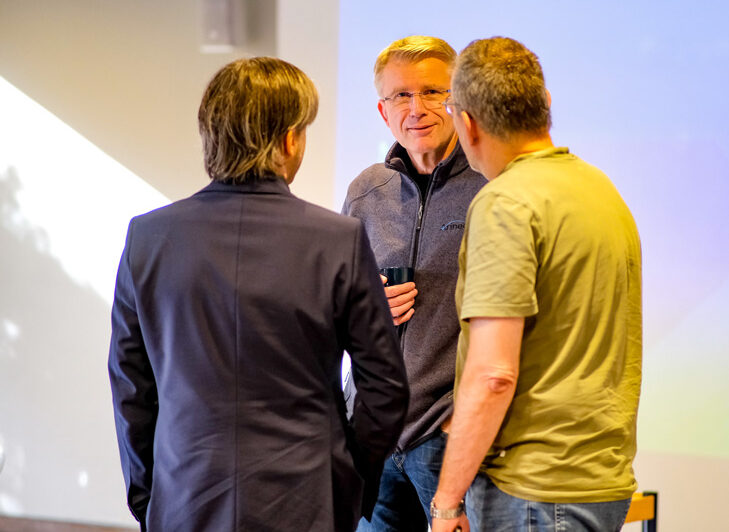
We spoke with Dr. Marko Weinrich, CEO of Arineo and author of the Codex as well as the stability criteria, about why financial KPIs belong to corporate culture, why not all profits can be distributed immediately, and why caution is sometimes the best form of entrepreneurial spirit.
Marko, what is the underlying principle behind the stability criteria?
Marko: We want to remain a company in the hands of its employees. Achieving this requires more than just formulating idealistic goals. We need clear economic guidelines. The criteria are designed to ensure that Arineo does not become over-indebted, illiquid, or dependent on balance sheet values that can change rapidly during a crisis.
The stability criteria serve as an early warning system and simultaneously provide a framework for responsible economic action.
They also help contextualize discussions that repeatedly arise in employee-owned companies: why don’t we simply distribute all profits? The answer is: because that would be dangerous. If we always end the year at zero, we will lack substance during the next crisis. Then a company can quickly run into problems.
Why are these criteria included in the Codex rather than in an internal financial plan?
Marko: Because they need to be firmly anchored. A financial plan can quickly change. The Codex carries more weight. It explains why we do things and which principles are important to our ownership and organizational model.
Of course, the Codex can also be amended. This requires a four-fifths majority in the Presidency and the General Assembly.
It is important to me: you can change things, but must know what you’re doing. Anyone who changes these stability foundations alters the company's security architecture.
Many associate corporate culture with teamwork, leadership, or values. Why do you believe financial KPIs also belong to it?
Marko: Because corporate culture describes how a company makes decisions. If we say that responsibility, long-term thinking, and reliability are part of our values, these values must be reflected in our economic actions. The stability criteria ensure that we not only describe our values but act accordingly every day. They make our culture measurable.
Our Codex and the Stability Criteria at a Glance
The Codex
The Arineo Group’s stability criteria are enshrined in the Codex. The Codex is not a classic code of conduct, which primarily describes rules for everyday work. Rather, it is a binding framework for our business model. It sets out the principles according to which Arineo will be managed, steered, and developed as an employee-owned company. This includes questions of responsibility, profit utilization, and economic stability.
The Stability Criteria
Our stability criteria are part of the Codex. They provide management with binding guidelines for economic steering and are tailored to the company, industry, and market environment. The criteria include, among other things, profitability, revenue growth, equity ratio, liquidity, cash flow, debt, asset cover, corporate values, and rules for corporate acquisitions.
The goal is to keep Arineo capable of action in the long term, make risks visible early on, and ensure that profits are used responsibly: first for securing livelihoods and the group’s development, then for training employees, and – if economic conditions permit – also for special payments to employees. The achievement of the stability criteria is an annual topic at the main committee meeting, the assembly of the management, presidency, and supervisory board.
The Codex states that profits generally serve to ensure the Arineo Group’s livelihood. What does this mean in concrete terms?
Marko: The target value for annual profit is five to seven percent of net income after tax in relation to revenue. Until the end of 2036, we must also use part of the profits for capital services, i.e., financing the purchase of the Arineo Group. The background is that Arineo’s founding was made possible by private investors. In January 2025, we were able to realize the conversion of the company into an employee-owned company and buy back the company from the investors. We needed a loan for this, which we will probably repay over the next 10 years.
If a net result of more than seven percent is achieved, management can distribute a special payment to employees. But only if the stability criteria are subsequently maintained as well. This is important to me: if we generate excess profits, they should benefit the employees. But not at the expense of the future.
That means that success is shared, but only when the foundation is stable?
Marko: Exactly. Success should be shared. But first, we must ensure that Arineo remains permanently capable of action. We only have security if we generate profits. And if we earn more than we need for stability and development, then we can distribute something – not to external shareholders, but to the employees.
That is a central difference for me. Our model is not designed to serve the capital interests of outsiders. But precisely because of this, we must pay particular attention to the company.
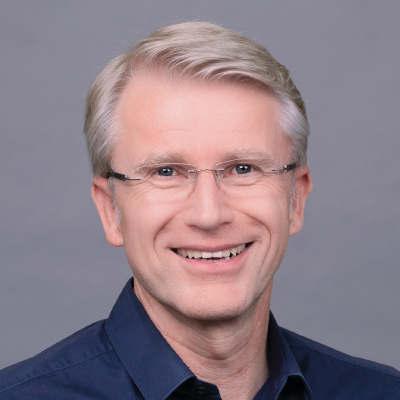
“I have crisis experience. I have seen what can happen when framework conditions suddenly change. The stability criteria are my answer to that.”
Dr. Marko Weinrich, Chairman of the Executive Board
Which KPIs do you consider particularly important?
Marko: The most important factors are equity capital, liquidity, and adjusted equity capital.
- Equity capital shows how solidly a company is financed.
- Liquidity shows whether we remain solvent in the short term and capable of action.
- Adjusted equity capital is particularly important because it deducts, among other things, activated business or brand values from the equity capital. This allows us to see more clearly how much substance actually exists.
I want to avoid a situation where a company appears stable on paper, but a large part of its equity capital consists of brand assets that must be written off in an emergency. That is what can bring companies down.
Can you explain that with an example?
Marko: Let’s say a company buys another company and allocates a high brand value to it in the balance sheet. As long as everything goes well, the balance sheet looks stable. However, if this brand value is permanently impaired – for example, because the acquired company enters economic difficulties or becomes insolvent – it must be written off. This write-off burdens the results and can erode equity capital. So a company that previously seemed healthy can suddenly be under massive pressure due to a balance sheet correction.
This is particularly relevant for an IT service provider like Arineo. Our most important asset is the people who work for us. However, this does not appear in the balance sheet. What can appear in the balance sheet are participations or corporate assets. One must handle these carefully.
That’s why we internally write off corporate assets over five years and limit purchase prices for companies. They should generally not exceed five times the average annual EBIT of the past three years. Higher purchase prices are only possible if our stability criteria continue to be met thereafter.
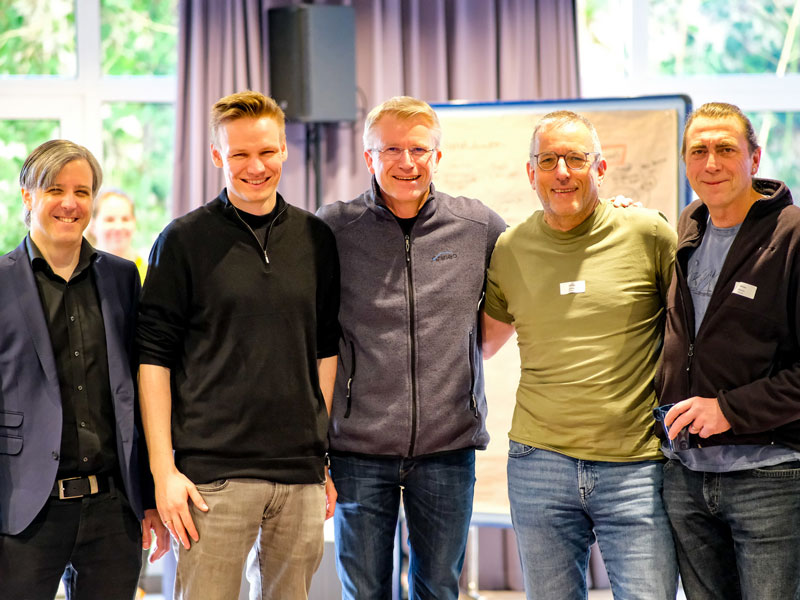
Marko with five members of the twelve-member management team of Arineo GmbH: Dr. Thomas Brodag, Leandro Meermeier, Dr. Marko Weinrich, Dr. Frank Wilkes, Martin Renker (from left to right)
That sounds very cautious.
Marko: Yes, and that is also deliberate. In this context, caution is not a negative thing. It protects our freedom. We do not want to get into a situation where we lose our ability to act due to excessively high purchase prices, insufficient liquidity, or too thin equity capital. Arineo should grow, but not at any price.
Speaking of growth, the Codex states an average revenue growth target of at least 10% over three years. Why is growth a stability criterion for Arineo?
Marko: In our industry, size, revenue, and personnel are also competitive criteria. If we are too small, we will be less visible. Then we can have difficulty keeping up with certain developments, such as in the Microsoft environment or with AI topics.
And that is precisely why we should lie above the industry growth rate in the long term. Not because growth is an end in itself, but because we thereby gain importance and strengthen our future viability. We will not achieve this goal every single year. That’s why we consider it over a period of three years, five years during crises.
The stability criteria also include resignations and fluctuations. Why do these key figures belong to it?
Marko: Because stability does not only consist of balance sheet and liquidity. For an IT service provider, employees are the decisive factor. If many people leave, that says something about the organization. There may be good reasons for individual developments, but the key figure should not be ignored.
That’s why we also look at how many resignations occur outside the probationary period and how they unfold.
What is important is not to change a rule immediately every time a red number appears. What is important is to talk about it and understand what lies behind it.
What happens if a criterion is not met?
The Codex does not include sanctions. The focus is first on transparency and discussion. If a KPI has been in the red for several years, it must be discussed. Is there an understandable explanation? Is it a temporary situation? Do we need to take countermeasures? Or is the criterion incorrectly set?
The KPIs must be examined at least once a year. Then management and committees can decide: are they being met? Do we change them? Or do we consciously explain why a deviation is justifiable?
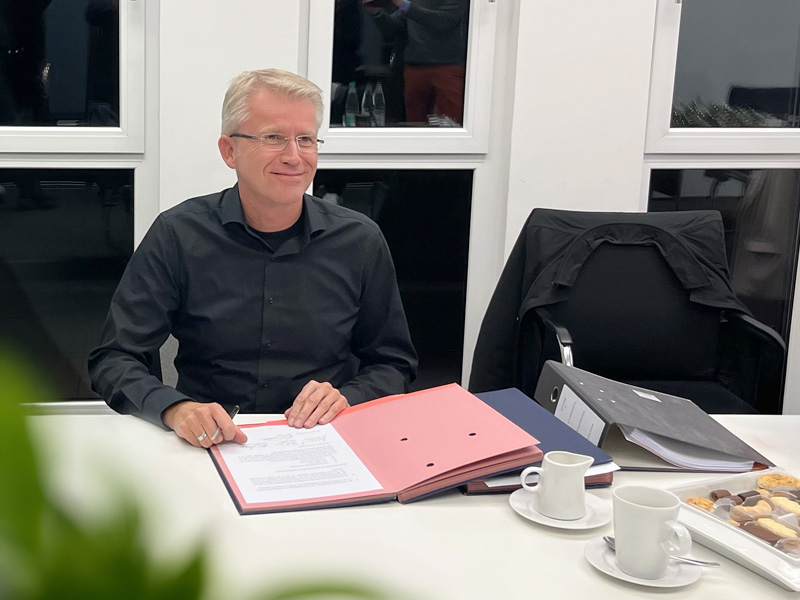
Dr. Marko Weinrich, when signing the transfer of Arineo GmbH into a foundation company.
What should employees take away from the stability criteria?
Marko: That economic success is not abstract. It secures our jobs, our freedom, and our model. If we distributed all profits immediately, that would be attractive in the short term but risky in the long term.
The better everyone understands what it takes economically, the more likely they are to help preserve Arineo. This is what it’s about: employee ownership does not only mean participation in success. It also means taking responsibility for the stability of the company.
And our client companies?
Marko: For client companies, not every criterion may be of interest. But the basic message is important: Arineo is not only cooperatively organized and employee-owned, but also clearly and economically managed. Some people associate such forms of organization with grassroots democracy or a lack of commitment. That’s not us. We have clear structures, strict financial criteria, and a common interest in long-term success. This creates reliability.
Is that also a signal against the prejudice that an employee-owned company is less economical?
Marko: Yes. Our model does not mean that we think less economically. On the contrary. If the company belongs to the employees, we must manage it particularly carefully. We bear the responsibility ourselves. Therefore, trust and economic discipline belong together. One cannot function without the other.
What is particularly important to you in the Codex as a whole?
Marko: Der KoThe Codex should provide security while enabling change. It describes why we do things. But it also says:
If we find better ways that achieve the same or more, we can make changes. That’s what’s important to me.
We don’t want to be dogmatic. But we want to act consciously. Whoever changes structures must understand their function. This applies to our organizational form as well as to our stability criteria.
What will Arineo recognize in a few years as evidence that the criteria have worked?
Marko: Quite simply, we will still exist. We will not be over-indebted, we will have a successful business, and we will remain capable of action. If we adhere closely to the criteria, we will repay our loans, generate additional funds for the future, and continue investing. Then the criteria will have served their purpose.
Thank you for the discussion!

