
Understanding people, communicating clearly, and finding solutions as a team
Why is communication so important in training and at work?
Kian (Office Management Trainee): Without good communication, things simply don’t run smoothly at work. For example, if I don’t fully understand tasks or can’t ask clear follow-up questions, I’m more likely to make mistakes or waste time. For me, good communication is the key to handling work assignments correctly.
In general, good communication ensures smooth collaboration. Teams need to coordinate, share information, and solve problems together. If that doesn’t work, misunderstandings, stress, and unnecessary mistakes can happen very quickly.
What was covered in the workshop? Can you give us some examples?
Kian: We started with the fundamentals of good communication. We looked at the sender-receiver model and the iceberg model. In small role-playing exercises, we were able to apply what we had learned right away. After that, we focused on active listening, questioning techniques, and effective feedback. This included both giving feedback and learning how to accept constructive feedback ourselves. At the end, we applied the methods again in practical exercises and reflected on the workshop together.
Why does communication play such an important role in our IT training programs, which focus on data and process analysis as well as application development?
Lukas (IT Trainee for Data and Process Analysis): Communication is important because we need to clearly understand what’s required. Requirements are often unclear or not described in technical terms, so it’s essential to listen carefully and ask the right questions. We also need to explain our solutions in a way that people without technical knowledge can understand. Communication is equally important within the team for coordination, problem-solving, and achieving good results together. Without good communication, misunderstandings and mistakes happen quickly.
Tomke (IT Trainee for Application Development): Exactly. In discussions with other project team members, we exchange ideas and think together about the best way to solve problems. At first, I was a bit reserved, but over time I became more confident and could contribute more actively. Feedback discussions are also part of the job. They’re not always easy, but they’re very important for improving and growing. Strong communication skills are essential for that. Communication also matters in school – whether with teachers or classmates. You really notice that things go more smoothly when you communicate openly and listen well.
Become part of our team. Reshape your career.
Do we suit you? Then send us your application now! We are looking forward to getting to know you and your capabilities.
What was your personal highlight of the workshop?
Kian: My personal highlight was the role-playing exercises after the short theory sessions. They allowed us to put what we learned directly into practice and better understand why good communication is so important.
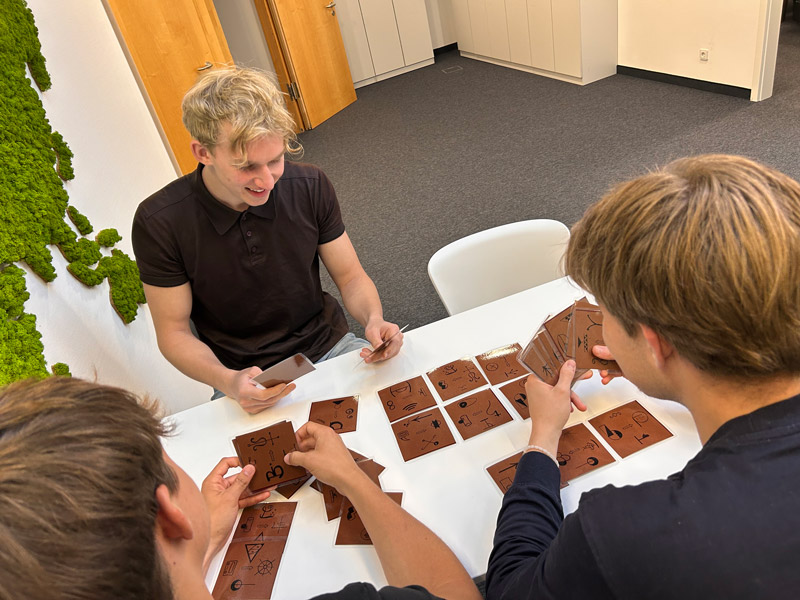
One activity that stood out involved arranging cards into a specific pattern. That was the only information we were given. There were six players, and each person had five cards that had to remain face down. The goal was to understand the game’s logic through communication with the other players. We described the patterns on our cards to one another. In the end, we had to identify the pattern for arranging the cards on the table. What made it challenging was that once the first card was placed on the table, we only had one attempt and just one minute to complete the pattern correctly. After moving the cards around several times and having an intense discussion that lasted much longer than the allotted time, we managed to solve the puzzle – but unfortunately, we didn’t win the game.
What communication skills should pupils bring to an IT career, and are they different from those needed in office management training?
Kian: It helps if pupils enjoy explaining things clearly and feel comfortable approaching other people openly. Being able to listen carefully is just as important so tasks can be understood correctly and questions can be asked when something is unclear. Anyone who can express themselves clearly and handle feedback constructively already has many important skills for everyday work.
There aren’t many major differences compared with office management training. Good listening, clear communication, and professional interaction with others are important there as well. For me, this is especially visible when communicating with applicants. In the end, the communication skills themselves are quite similar – the main difference lies in the specific tasks and areas of responsibility.
Why is communication so important at work?
Communication in training, and especially in IT training, is much more than just a nice extra. It helps people understand tasks correctly, avoid misunderstandings, and develop solutions together as a team. Anyone who asks clear questions, listens carefully, and explains ideas understandably works more confidently and effectively. This is especially important in an IT services company, where technical topics often need to be explained to very diverse audiences.
Conclusion: technology and communication go hand in hand
Kian: Good communication isn’t just an additional skill – it’s a key part of successful collaboration. It helps within teams, in projects, and in communication with clients. That’s exactly why it should be part of training from the very beginning.
For pupils, this means: if you’re curious, ask questions, enjoy teamwork, and communicate openly, you already have important qualities for a successful career.

